
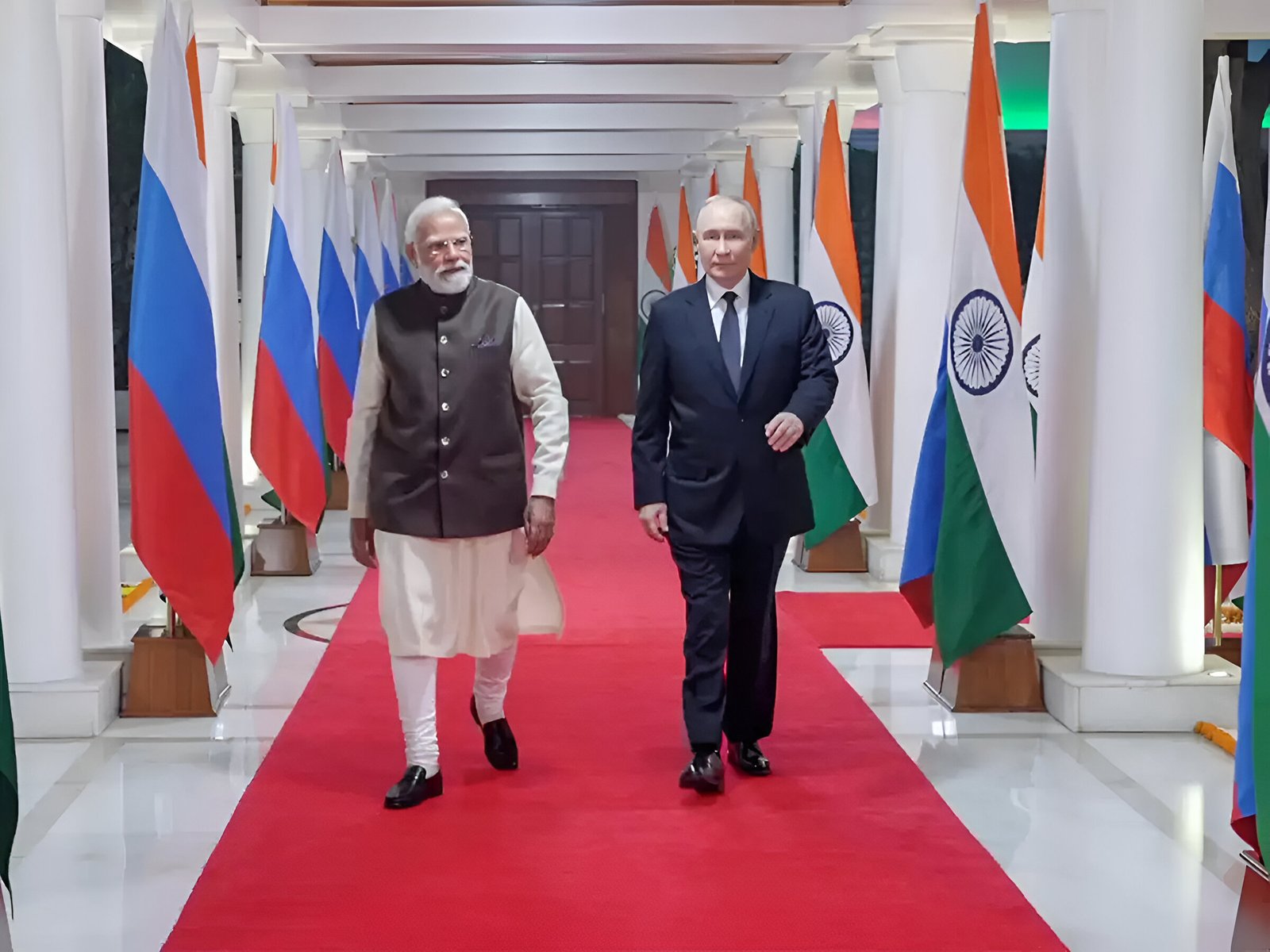
When Russian President Vladimir Putin landed in New Delhi for his state visit, one image instantly dominated the news cycle: Prime Minister Narendra Modi personally receiving him at the airport, followed by both leaders driving off in the same car.
In diplomatic protocol, that small detail is a big statement. Normally, visiting leaders are received by senior officials like the Foreign Secretary or a cabinet minister. When the head of government himself goes to the airport, it’s reserved for a very select circle of partners. Modi’s gesture, combined with his tweet calling Putin “my friend” and praising the “time-tested” India–Russia friendship, was meant as a signal — not just to Moscow, but to Washington, Europe, and Beijing as well.
All of this is happening at a time when:
- The US has imposed high tariffs on Indian goods and is pressuring India to cut Russian oil purchases.
- Russia is under heavy Western sanctions and being portrayed as “isolated” since its invasion of Ukraine.
- India is trying to maintain “strategic autonomy” — buying cheap Russian oil, deepening Western ties, and managing China, all at once.
So what does this visit really mean? Let’s break it down.
1. The Airport Welcome: A Message Wrapped in Optics
Modi’s tweet read, in essence: delighted to welcome my friend President Putin to India; looking forward to our interactions; India-Russia friendship is time-tested and has greatly benefited our people. That, plus the hug at the airport and both leaders riding in the same car, was a carefully crafted visual message.
- Breaking protocol – signals that Putin is not “just another visitor” but a special partner.
- Timing – this warmth comes exactly when the West wants India to distance itself from Moscow over Ukraine and oil trade.
- Audience – the message is aimed outward (US, EU, China) and inward (Indian public opinion, business community, strategic establishment).
It says, in effect:
“India will decide its partners based on its own interests, not someone else’s pressure.”
2. “Sukh-Dukh Ka Saathi”: Why Russia Still Matters to India
In the video you’ve shared, the speaker quotes Commerce Minister Piyush Goyal telling a Russian delegation that if you ask any Indian, they’ll say:
Russia is India’s ‘sukh-dukh ka saathi’ — a companion in good times and bad times.
Historically, that’s not entirely wrong. During the Cold War and post-1971 period, the USSR (and later Russia) backed India on:
- Defense – supplying fighter jets, tanks, submarines and missile systems for decades. Even today, about 60–70% of India’s military inventory is of Russian origin, though the share in new imports is falling.
- Diplomacy – repeated vetoes at the UN Security Council in India’s favour on sensitive issues.
- Energy & nuclear cooperation – from oil and coal to nuclear reactors.
Indian culture places a lot of value on the friend who stands with you in a crisis, not just in prosperity. That emotional framing — “sukh-dukh ka saathi” — is being used to justify why India won’t suddenly drop Russia just because the global mood has shifted.
Of course, as the speaker rightly points out, geopolitics is about interests, not personal friendship. But at this moment, India and Russia’s interests overlap enough — energy, defense, multipolar world order — that both sides see value in staying close
3. What Russia Gains from This Summit
For Russia, this visit is not just about signing a few agreements. It’s about optics, leverage, and survival.
3.1 A major buyer of oil, arms and more
India has become one of Russia’s biggest buyers of:
- Crude oil – especially discounted crude after Western sanctions.
- Fertilizers and coal – critical for India’s food security and power sector.
NDTV Profit - Weapons and spare parts – though the share is declining, Russia is still India’s largest arms supplier (36% of imports in 2020–24, down from 72% a decade ago).
That alone makes India a lifeline for Russia’s sanctions-hit economy.
3.2 Proving “we are not isolated”
Western strategy post-Ukraine has been to box Moscow in — diplomatically, militarily, and economically. Putin’s warm welcomes in Beijing and now New Delhi give him a powerful counter-narrative:
“Look at how isolated I am — being honoured in China and India, two of the world’s biggest economies.”
The airport visuals, the joint statements, business forums, and ministerial meetings all reinforce the idea that Russia still has serious partners outside the West.
4. The Trade Story: $68.7 Billion, but One-Sided
One of the most important — and problematic — parts of the relationship today is trade.
Total trade (FY 2024–25): about $68.7 billion
India’s exports to Russia: ~$4.9–4.88 billion
India’s imports from Russia: ~$63.8 billion, driven mainly by crude oil, coal, fertilizers, and sunflower oil.
The Indian Express
That means the relationship is heavily tilted:
India is mostly buying from Russia, not selling to it.
This is why in the summit build-up, both sides have talked about:
- Increasing Indian exports of automobiles, machinery, electronics, food products to Russia.
Reuters - New payment systems to bypass sanctions-hit Western channels.
The Financial Express - A long-term target of $100 billion in bilateral trade by 2030, but with a more balanced structure.
Reuters
Right now, it is more “massive purchasing from Russia” than genuine two-way trade. That’s a strategic risk for India, especially if discounts shrink or sanctions tighten further.
5. Defense: From Dependence to Diversification
For decades, Russia dominated India’s defense imports. Around 2010–14, roughly 72% of India’s arms imports came from Russia. Today, that share has dropped to about 36%.
Why the shift?
- Make in India & Aatmanirbhar Bharat – India wants to build more at home.
India Today - Diversification – Rafale jets from France, Apaches and drones from the US, and growing Israeli cooperation.
The Times of India - Sanctions risk – India has to factor in supply chain disruptions and sanctions on Russian defense firms.
During this visit, there’s intense speculation about:
- Additional S-400 air defense systems
- Upgrades or possible deals related to Su-57 fighters
- Submarine projects and engine upgrades for Russian-origin tanks.
But as the transcript correctly notes, we shouldn’t get carried away by headlines claiming “massive new billion-dollar submarine deal signed” without evidence.
6. Fact-Checking the Hype: The “Nuclear Submarine” Story
One viral claim in Indian and Western media recently was that Russia was about to give India a new nuclear attack submarine on lease under some fresh mega deal.
According to official clarifications and fact-checks:
- The only nuclear submarine lease arrangement commonly referred to is based on a contract signed in March 2019, long before this summit.
- Delivery has been delayed multiple times, with a tentative new schedule around 2028, and even that is uncertain due to Russia’s own industrial and war-related pressures.
- There is no confirmed new nuclear submarine deal announced in connection with the current visit.
This is a classic example of why the speaker warns against blindly amplifying unverified “breaking news”. In geopolitics, planted stories and exaggerated leaks are extremely common — especially when Western and Russian narratives are colliding.
7. The RELOS Agreement: A Quiet but Big Deal
One of the most interesting — and under-discussed — aspects is the RELOS Agreement:
| Reciprocal Exchange of Logistics Support
In simple terms, this allows Indian and Russian militaries to use each other’s bases, ports, and logistics facilities for refuelling, repairs, and support during exercises or operations.
Russia has already approved and ratified the RELOS agreement ahead of Putin’s visit.
Vajiram & Ravi
On the Indian side, there has been notably little public communication, even though India has similar logistics pacts with countries like the US, France, Australia, and others.
If fully operationalised, RELOS would mean:
- Russian warships and aircraft could access Indian naval and air bases for logistics support.
- Indian ships and aircraft could similarly use Russian facilities in the Arctic, Far East, and other regions.
Given India’s desire to avoid being seen as “too close” to either the US or Russia, New Delhi is handling this very quietly. It’s significant for military planners, but politically sensitive.
8. Energy, Uranium, and the Less Glamorous But Crucial Deals
The most glamorous headlines are always about missiles, submarines, and fighter jets. But for this summit, the real heavy lifting is likely happening in:
- Oil & gas – securing long-term discounted supplies while navigating sanctions.
- Fertilizers and coal – critical for India’s farmers and power consumers.
- Nuclear fuel (uranium) – as India talks to Canada and others about uranium deals, Russia is pitching itself as another reliable supplier.
These are not flashy press-conference topics, but they affect inflation, food security, electricity prices, and long-term energy strategy in a very concrete way.
9. Balancing Between Moscow and Washington
All of this is happening against the backdrop of:
A more confrontational US foreign policy, including tariffs and pressure over Russian oil.
Western worries that India is “helping” Russia by buying its crude and reducing the bite of sanctions.
India’s own security concerns about China, which is growing closer to Russia.
India’s answer has consistently been:
- We will buy where it suits us, whether that’s Russian oil or American aircraft.
- We will talk to everyone, from Washington to Moscow to Brussels and Tokyo.
- We will resist being forced into a “camp” — no Cold War-style alignment.
Put simply, New Delhi wants cheap energy from Russia, high-tech and markets from the West, and deterrence against China — all at the same time. That’s a very difficult balancing act, and visits like this are part of the tightrope walk.
10. Why the Speaker Keeps Saying: “Stick to Genuine News”
The transcript ends with a strong warning: don’t fall for every spicy headline about India–Russia defense deals or dramatic “game-changing” agreements.
That’s smart advice, because:
- Western outlets sometimes overplay India–Russia defense ties to paint India as undermining sanctions.
- Russian media sometimes overhypes the partnership to show domestic audiences that Moscow still has powerful friends.
- Indian media can copy-paste both sides without rigorous fact-checking.
In a world of social-media-driven geopolitics, where narratives are weapons, staying anchored to hard data, official documents, and credible sources is more important than ever.
In Summary
Putin’s visit to India — and Modi’s decision to greet him personally at the airport — is not just a ceremonial event. It encapsulates:
- A historical partnership that India still values, especially in energy and defense.
- A massive but lopsided trade relationship that both sides are now under pressure to rebalance.
- A shifting defense landscape, where Russia is still important but no longer dominant.
- A fierce information war, in which both Western and Russian narratives try to claim India for their side.
India’s message, through its actions more than its words, is clear:
“We will engage with Russia, work with the West, and ultimately make decisions based on Indian interests — not anyone’s pressure.”