
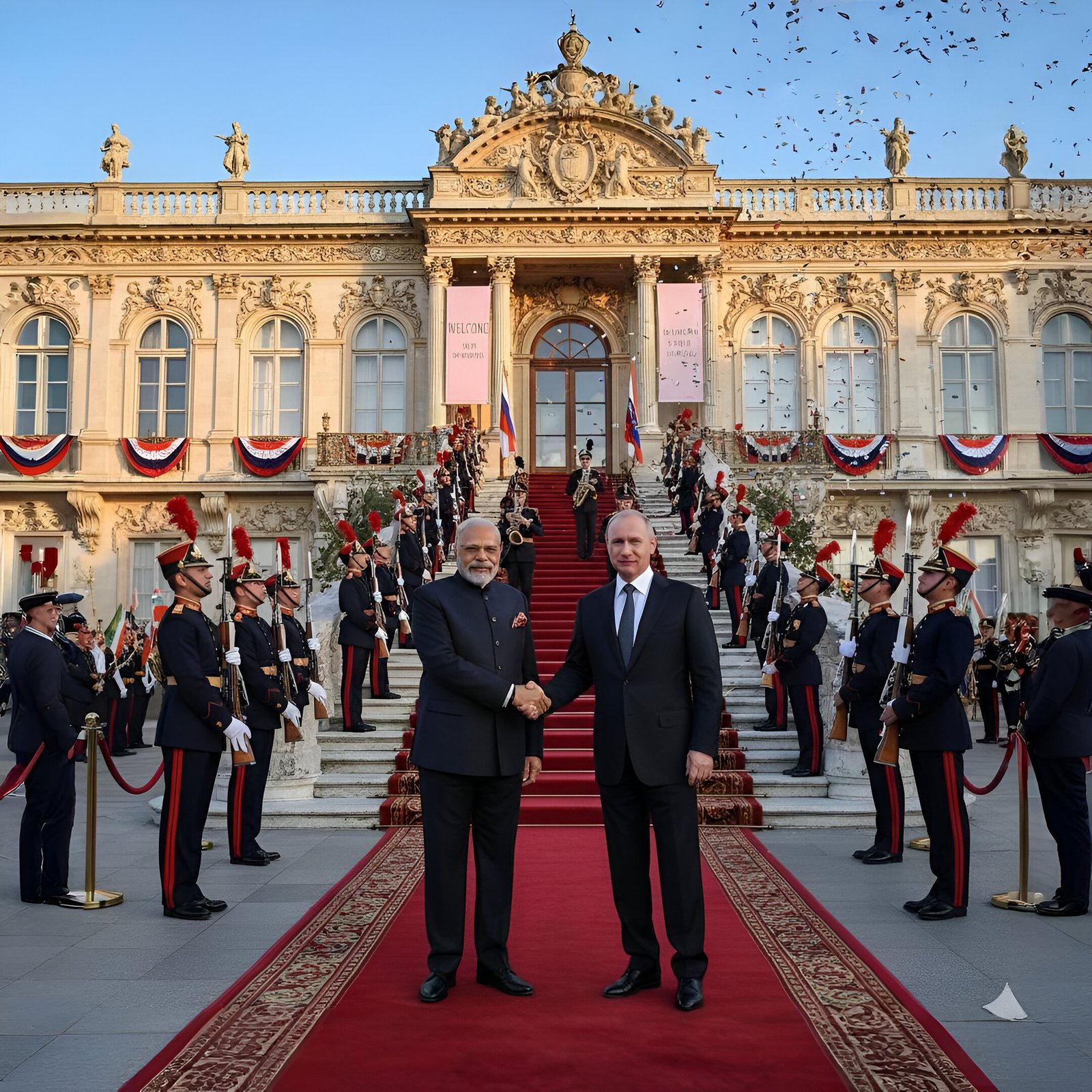
“Namaskar, welcome to Career 247…” — with this familiar line, Prashant Dhawan opens another deep dive into global politics, this time connecting Donald Trump’s foreign policy, Vladimir Putin’s recent comments, and India’s rising economic stature.
According to him, because of Trump-era policies, India–Russia relations are now at one of their strongest points in decades. The tone from both New Delhi and Moscow has shifted from cautious cooperation to openly warm and strategic language that we hadn’t seen for almost twenty years.
The turning point? A rare, direct interview that Vladimir Putin gave to an Indian news outlet. That alone is symbolic: usually, such high-profile conversations go to Western giants like BBC or CNN. This time, the Russian president chose Indian media—questions in English, answers in Russian—signalling how seriously Moscow now takes India’s role in the world.
Trump’s Offer: “Come Back to the G8”
In that interview, Putin confirmed something that had long been discussed in diplomatic circles:
- The United States, under Donald Trump, explored ways to bring Russia back into the G7, restoring it to the old G8 format.
- The idea was simple: if Russia cooperated on the Ukraine conflict and allowed the US to claim some diplomatic success, it could be welcomed back into the “club” of advanced economies.
Historically, Russia was part of the G8 until 2014, when it was suspended after the annexation of Crimea. What was once G8 went back to G7, with Russia out in the cold.
Now, Putin has openly stated that yes, the offer existed—but he isn’t interested.
“Why Would I Go Back?” – Putin’s Big Statement
In the interview, Putin makes a striking, almost brutal, geopolitical point:
He has no desire to rejoin the G7 or turn it back into G8.
Instead, he says he is far more interested in deepening ties with India. And to justify that, he uses a very specific economic lens: Purchasing Power Parity (PPP).
Putin points out that:
- By nominal GDP, the US is No. 1, and India ranks around 5th in the world.
- But by GDP in PPP terms,
- China is No. 1,
- the US is No. 2,
- India is No. 3,
- and Russia itself comes at No. 4.
From this perspective, India is already the world’s third-largest economy, and Russia is just behind it. For a leader who wants to project strength and long-term relevance, it makes far more sense to invest in partnerships with rising economies than with “ageing” ones whose global share is shrinking.
Nominal GDP vs PPP: Why It Matters to Putin
A lot of people in India might be tempted to say, “Is Putin just flattering us?” But the explanation is more technical:
- Nominal GDP measures a country’s economy at current market exchange rates. It’s useful for comparing raw financial power, global borrowing, and trade in international currency.
- GDP (PPP) adjusts for the cost of living and what money can actually buy inside each country.
For example:
- With ₹500 in India, two–three people can eat a decent meal.
- The same ₹500 converted into dollars would barely cover one person’s modest meal in the US.
So in PPP terms, a rupee “stretches” much further in India than a dollar does in America. This is why, when you adjust for purchasing power, India’s economy looks much larger than in nominal terms.
For Putin, PPP is a logical way to argue that:
- The real economic gravity is shifting towards countries like China, India, and Russia,
- While the G7’s share of global GDP is steadily shrinking, and the BRICS bloc’s share is rising. In other words, from his standpoint:
“Why chase a seat at a shrinking table, when I can partner with countries where the future growth actually is?”
G7 vs BRICS: Declining West, Rising “New Powers”
This leads to a broader strategic narrative:
- The G7 was created as a club of the world’s richest, most advanced economies.
- Over time, their share in global GDP has steadily declined, as emerging economies have grown faster.
- The BRICS group (Brazil, Russia, India, China, South Africa, and new entrants) today accounts for a larger share of world output than the G7 when measured in PPP terms.
Putin’s message is clear:
- He sees India and the broader Global South as the real engines of future growth.
- Rather than trying to squeeze back into Western clubs, he wants to build deeper, more equal partnerships in Asia and Eurasia.
And India sits right at the centre of that strategy.
India–Russia: Towards a Free Trade Agreement and a 2030 Roadmap
Looking ahead, the video points to some very concrete steps being discussed between India and Russia:
-
-
-
A large-scale Free Trade Agreement (FTA)
- Not just with Russia alone, but with the Eurasian Economic Union (EAEU) — a bloc that includes Russia, Kazakhstan and several other former Soviet republics.
- If signed, this would mean easier trade, lower tariffs, and deeper integration across a wide region, not just bilateral India–Russia flows.
- A 2030 Roadmap for Trade
- The target: $100 billion in bilateral trade by 2030.
- This includes energy, defence, machinery, food products, pharma, and more
- Rupee–Ruble Trade
- Putin himself has noted that around 90% of India–Russia trade is now settled in rupees and rubles, not in US dollars.
- This is a deliberate move to de-dollarise parts of their trade and reduce vulnerability to Western sanctions or financial pressure.
-
-
On paper, the values are still shown in “US dollars” for global reporting and media, but at the transactional level local currencies are increasingly doing the real work.
Putin’s Style vs Indian Diplomacy
The speaker also makes an interesting comparison between Russian and Indian political styles.
- Putin, whatever his many controversies, is known for being blunt and fearless in his statements.
- When he says he has no interest in the G7 and calls out Western economies as “declining,” he does it openly, directly, and on record.
- He is willing to tell an Indian media outlet, in front of the world, that he prefers betting on India’s growth story over rejoining Western clubs.
In contrast, Indian leaders tend to be:
- More cautious and diplomatic,
- Very careful with wording,
- Focused on avoiding unnecessary provocation, especially when dealing with the US, EU and China simultaneously.
This difference in style doesn’t mean India is weaker; it simply reflects New Delhi’s need to balance multiple relationships at once, while Moscow is already in an open confrontation with the West and has less to lose by using sharp language.
What This Means for Students and Professionals
For viewers of a channel like Career 247, there’s an extra layer of learning here. The episode doesn’t just explain geopolitics; it also shows why understanding data, GDP metrics, and long-term trends actually matters in real life:
Leaders are making huge strategic decisions based on economic data and projections (like PPP vs nominal GDP).
Countries are re-designing trade and currency systems to work around sanctions and dollar dominance.
Blocks like BRICS and the EAEU are using numbers to justify their push for a more “multipolar” world.
That’s why the video smoothly transitions into talking about data analytics as a career path:
- The Career 247 data analytics course, powered by IBM, is highlighted as a way for students to build real, job-ready skills.
- The focus is on live classes, mini-projects after every module, and two major live projects that prepare learners for interviews.
- With demand for data analysts rising globally (not just in India but also in Europe and the US), having data skills can make you “the golden boy or girl of the office,” even if you’re not a full-time data scientist.
The message is simple:
In a world where leaders argue using GDP models and trade numbers, knowing how to work with data isn’t just a career advantage — it’s a way to truly understand what’s happening around you.
Final Thoughts
From Trump’s offer to restore the G8, to Putin’s public rejection of the idea, to his praise for India as the world’s third-largest economy in PPP terms, this story shows how rapidly the global centre of gravity is shifting.
- The West’s share of global power is shrinking,
- BRICS and emerging economies are rising,
- And India is moving to the heart of every major calculation — whether it’s energy, trade, defence, or technology.
For Indians watching this unfold, there are two big takeaways:
- Geopolitically, India is no longer a side character; it’s one of the main players in the script.
- Personally, if you understand data, economics and global trends, you’re far better equipped to shape your own future—whether that’s in geopolitics, business, or a tech-driven career like data analytics.